Ever wonder why some people’s Quran recitation sounds so beautiful and clear while yours doesn’t quite hit the mark? You’re not alone. Even people who’ve been reciting for years make mistakes they don’t even know about. The good news? Most of these errors are surprisingly easy to fix once you know what to look for.
Common mistakes in Quran recitation happen to everyone, from complete beginners to those who’ve memorized portions of the Quran. Sometimes it’s a mispronounced letter. Other times, it’s rushing through verses or stopping at the wrong place. These small errors might seem harmless, but they can actually change meanings or break the flow of your recitation.
The beautiful part about Tajweed (the rules of proper Quran recitation) is that it’s teachable, learnable, and fixable. You don’t need years of Arabic study to improve; you just need to know what mistakes to watch out for and how to correct them.
In this guide, we’ll walk through the 10 most common Quran recitation mistakes people make and give you simple, practical ways to fix each one. Whether you’re learning on your own or teaching your kids, these tips will help you recite the Quran correctly and beautifully.
Why Correct Quran Recitation Matters
Before we dive into specific mistakes, let’s talk about why getting it right matters so much.
Importance of Tajweed
Tajweed literally means “to make better” or “to improve.” It’s the set of rules that teach us how to pronounce every letter and word in the Quran exactly as it was revealed to the Prophet Muhammad (peace be upon him).
Think of Tajweed like learning to play an instrument. You can know the notes, but if you don’t follow proper technique, it won’t sound right. Same with the Quran, you need proper technique (Tajweed rules) to make your recitation both correct and beautiful.
The Prophet (peace be upon him) said: “Verily the one who recites the Quran beautifully, smoothly, and precisely, will be in the company of the noble and obedient angels” (Sahih Bukhari). That’s how important proper Quran recitation is!
Preserving Meaning and Respect
Here’s something crucial: small pronunciation mistakes can completely change what a word means. Imagine mixing up “heart” and “dog” in English, totally different meanings, right? The same thing happens in Arabic.
For example, the word “قَلْب” (qalb) means “heart,” but if you mispronounce it, it might sound like “كَلْب” (kalb), which means “dog.” Clearly, that changes everything! Correct Tajweed ensures we’re saying exactly what Allah revealed, with the respect and accuracy His words deserve.
When you recite the Quran correctly, you’re not just reading words; you’re preserving a divine message that’s been passed down perfectly for over 1,400 years.
Mistake #1: Incorrect Pronunciation of Arabic Letters (Makharij)
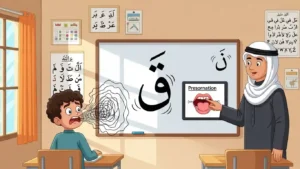
This is probably the most common mistake, especially for non-native Arabic speakers.
What Goes Wrong
Every Arabic letter comes from a specific place in your mouth, throat, or nasal passage; these are called Makharij (articulation points). Many letters sound similar to beginners, so it’s easy to mix them up.
Common confusions include:
- خ (Khaa) vs ح (Haa) vs ه (Haa)
- ق (Qaaf) vs ك (Kaaf)
- ص (Saad) vs س (Seen)
- ض (Daad) vs د (Daal)
When you don’t pronounce letters from their correct articulation points, you might accidentally say a different word with a completely different meaning.
How to Fix It
Step 1: Learn where each letter comes from. Watch videos or work with a teacher who can show you the exact mouth position for each letter.
Step 2: Practice in front of a mirror. Watch how your mouth, lips, and tongue move. Compare with correct demonstrations.
Step 3: Record yourself reciting, then listen back. Sometimes you don’t catch mistakes while you’re reading, but hearing the playback makes them obvious.
Step 4: Focus on one difficult letter at a time. Don’t try to fix everything at once. Master خ (Khaa) before moving to the next tricky letter.
Want to learn proper letter pronunciation? Our qualified teachers at Learn Quran Kids specialize in helping students master Arabic letters correctly from day one.
Mistake #2: Ignoring Tajweed Rules
Many people can read Arabic but skip the Tajweed rules entirely, thinking basic reading is enough.
Commonly Skipped Rules
The rules most often ignored include:
- Ghunnah (nasal sounds)
- Qalqalah (echoing certain letters)
- Idgham (merging sounds)
- Ikhfa (hiding sounds)
- Madd (elongation)
Without these rules, your recitation lacks the rhythm, beauty, and precision that make Quranic recitation special.
Simple Correction Approach
Don’t feel overwhelmed by all the Tajweed rules. Here’s a simple approach:
Start with the basics: Learn one rule at a time. Begin with Ghunnah since it’s one of the most common.
Use color-coded Qurans: These highlight which rules apply where, making it visual and easier to follow.
Listen actively: Put on a recording of a skilled Qari (like Sheikh Mishary or Sheikh Sudais) and follow along in your Quran. Notice how they apply rules you’re learning.
Practice daily: Even 10 minutes of focused Tajweed practice beats an hour of mindless reading.
Remember, the goal isn’t perfection overnight; it’s consistent improvement.
Mistake #3: Mixing Similar Arabic Letters
Certain Arabic letters look or sound similar, leading to frequent mix-ups.
Examples (س vs ص, ت vs ط)
Let’s look at common pairs that trip people up:
س (Seen) vs ص (Saad): Seen is light and clear, like the “s” in “sit.” Saad is heavy and full-mouthed. The difference is huge! “سَلَام” (salaam – peace) vs “صَلَاة” (salah – prayer).
ت (Taa) vs ط (Taa): The first Taa is light and soft. The second (with the dot underneath) is heavy and emphatic. Saying one instead of the other changes the whole word.
د (Daal) vs ض (Daad): Daal is light, Daad is heavy. Many non-Arabs struggle with Daad because it doesn’t exist in other languages.
Practice Techniques
Technique 1: Make flashcards with confusing letter pairs. Practice identifying them visually first, then by sound.
Technique 2: Find Quranic words containing these letters and practice them repeatedly. For example, practice words with both س and ص until you can clearly hear and produce the difference.
Technique 3: Work with a teacher who can listen and correct you. Sometimes you think you’re saying it right, but a trained ear can catch the subtle difference.
Technique 4: Use tongue twisters with these letters. It sounds funny, but it trains your mouth to quickly switch between similar sounds.
Mistake #4: Wrong Lengthening (Madd Errors)
Madd means elongation, stretching certain vowels for specific counts. Getting this wrong throws off the entire rhythm.
Shortening or Over-Stretching
There are different types of Madd:
- Madd Asli (Natural): 2 counts (like 2 seconds)
- Madd Waajib (Necessary): 4-5 counts
- Madd Lazim (Compulsory): 6 counts
- Madd Aarid: 2, 4, or 6 counts (flexible based on stopping)
The mistake happens when people either:
- Rush through and don’t stretch enough
- Hold the sound too long
- Use the same length for all Madd types
This makes recitation sound choppy or dragged out instead of smooth and flowing.
How to Measure Correct Length
Method 1: Use your fingers. Open and close them slowly, each open-close is one count. Practice stretching the sound for exactly 2, 4, or 6 finger movements.
Method 2: Count in your head: “one-two” for Madd Asli, “one-two-three-four” for Madd Waajib, etc.
Method 3: Listen to expert reciters and try to match their timing. Apps like Tarteel can show you visual representations of elongation lengths.
Method 4: Record yourself and count beats on playback. You’ll quickly see if you’re cutting short or dragging too long.
Struggling with Madd’s rules? Our structured Tajweed program breaks down complex rules into simple, easy-to-follow lessons. [Explore our online Quran classes →]
Mistake #5: Not Observing Ghunnah Properly
Ghunnah is that beautiful nasal sound used with certain letters.
Nasal Sound Errors
Ghunnah should be applied to:
- ن (Noon) with shaddah
- م (Meem) with shaddah
- Certain rules of Noon Sakinah and Tanween
Common mistakes include:
- Skipping the Ghunnah entirely
- Making it too short (less than 2 counts)
- Making it too nasal or exaggerated
- Applying it where it doesn’t belong
Correct Timing and Sound
Ghunnah should be exactly 2 counts, no more, no less. It should sound like a gentle humming from your nose, not forced or exaggerated.
Practice tip: Say “mmm” or “nnn” while gently holding your nose closed. Feel that vibration? That’s Ghunnah. Now practice making that sound while reciting words that require it.
Examples to practice:
- الرَّحْمَـٰنِ (Ar-Rahmaan) – The Noon with shaddah needs Ghunnah
- مِنَ النَّاسِ (min an-naas) – Apply Ghunnah on the merged Noon-Noon
Listen to Surah Al-Fatiha carefully. You’ll hear Ghunnah several times. Try to match that exact sound and length.
Mistake #6: Stopping at Incorrect Places (Waqf Mistakes)
Knowing where to pause or stop is crucial for maintaining meaning and breath control.
How Meaning Changes
Stopping in the wrong place can completely change what a verse means, or worse, make it say something incorrect.
For example, in Surah Al-Baqarah (2:2), if you stop after “لَا” (no) and then continue, you’re breaking up the phrase incorrectly. The meaning becomes distorted.
The Quran has Waqf signs (stopping signs) that guide you:
- ۘ (Meem) = Must stop
- ج (Jeem) = Allowed to stop
- لا (Laa) = Should not stop
- صلی (Sali) = Better to stop
Learning Correct Stops
Step 1: Learn the basic Waqf symbols in your Quran. Most Qurans have a guide at the beginning explaining these signs.
Step 2: Start by only stopping at clear stop signs. Don’t randomly pause for breath in the middle of sentences.
Step 3: If you must stop for breath, choose a place where the meaning is complete. Wait until you reach a natural pause point.
Step 4: Practice breathing exercises to increase your lung capacity, so you can recite longer verses without desperate mid-sentence pauses.
Remember: it’s better to take a proper pause at the right place than to rush through and break the meaning.
Mistake #7: Reading Too Fast Without Clarity

Speed-reading the Quran is one of the most common mistakes.
Speed vs Accuracy
Allah says in the Quran: “And recite the Quran with measured recitation (Tarteel)” (73:4). Notice it says “measured, not rushed, not racing, but clear and deliberate.
When you read too fast:
- You skip important Tajweed rules
- Letters get slurred together
- Articulation points become sloppy
- The beauty and meaning get lost
Remember, this isn’t a competition. The goal isn’t finishing quickly; it’s reciting correctly and beautifully.
Balanced Recitation Tips
Tip 1: Slow down to about half your current speed. Seriously. Most people need to go much slower than they think.
Tip 2: Focus on pronouncing every single letter clearly. Don’t let letters blur together.
Tip 3: Give every rule its due time. Ghunnah needs 2 counts, Madd needs its proper length, don’t rush these.
Tip 4: Use a metronome or timer. Start by reciting one verse in 30-45 seconds. As you improve, you can gradually increase speed while maintaining quality.
Tip 5: Record yourself. When you listen back, you’ll be shocked at how many mistakes speed caused that you didn’t notice while reading.
Quality over quantity. It’s better to recite one page perfectly than five pages sloppily.
Mistake #8: Incorrect Rules of Noon Sakinah & Tanween
These rules govern how Noon Sakinah (ن with sukoon) and Tanween (double vowel marks) interact with the following letters.
Idgham, Ikhfa, Iqlab Errors
There are four main rules:
Izhar (Clear): Pronounce the Noon clearly when followed by throat letters (أ ح خ ع غ ه)
Idgham (Merging): Merge the Noon into the next letter when followed by (ي ر م ل و ن)
Iqlab (Conversion): Convert Noon sound to Meem when followed by (ب)
Ikhfa (Hiding): Hide the Noon with Ghunnah for the remaining 15 letters
Common mistakes:
- Pronouncing Noon clearly, where it should be merged or hidden
- Forgetting Ghunnah where required
- Not converting to Meem sound in Iqlab
- Applying the wrong rule for the wrong letter
Easy Identification Method
Memory trick: Learn the letter groups for each rule. Make flashcards or use the first-letter memory technique.
For Idgham letters, remember: “يرملون” (Yarmaloon) – these are the 6 merging letters.
Practice method:
- Identify if you have Noon Sakinah or Tanween
- Look at the next letter
- Ask: “Which group does this letter belong to?”
- Apply the correct rule
Color-coded Qurans make this easier by highlighting these rules in different colours. Green might be Ikhfa, red might be Idgham, etc.
Practice these rules in Surah Al-Fatiha first; it contains great examples of all four rules in just seven verses!
Mistake #9: Neglecting Heavy & Light Letters (Tafkheem & Tarqeeq)
This mistake affects the overall quality and sound of your recitation.
Sound Distortion
Tafkheem (heaviness) means making letters full-mouthed and thick. Tarqeeq (lightness) means keeping letters thin and clear.
The seven heavy letters are: خ ص ض غ ط ق ظ (Remember: “خُصَّ ضَغْطٍ قِظْ”)
These letters should always sound heavy, full, and echoing. Other letters should stay light and clear.
Common mistakes:
- Making light letters heavy (like pronouncing ت as if it’s ط)
- Making heavy letters light (losing the fullness of ص)
- Not adjusting the letter Raa (ر) correctly, it can be heavy or light depending on the vowels
This distortion makes your recitation sound flat or incorrect.
Training the Tongue and Mouth
Exercise 1: Practice heavy letters in isolation. Feel how your tongue rises toward the roof of your mouth, creating that full, thick sound.
Exercise 2: Contrast pairs. Say ت (light Taa) then ط (heavy Taa) back and forth. Feel the difference in your mouth position.
Exercise 3: Practice Raa rules:
- Heavy after Fatha or Damma: رَ رُ
- Light after Kasrah: رِ
- Silent Raa follows the vowel before it
Exercise 4: Find verses with both heavy and light letters close together. This trains your mouth to quickly switch between the two qualities.
Example: “صِرَاطَ” (Sirat) – The Saad is heavy, but the Raa after Kasrah is light. Practice this contrast.
Mistake #10: Learning Without a Qualified Teacher
This is the biggest mistake that leads to all the others.
Self-Learning Limitations
Yes, there are great apps, videos, and resources for learning the Quran. But here’s the problem with learning alone:
You can’t hear your own mistakes. Your brain fills in what you meant to say, not what you actually said.
Bad habits form quickly. Without correction, you practice mistakes over and over, making them harder to fix later.
No personalized feedback. Generic videos can’t tell you specifically what YOU need to work on.
Slow progress. Self-learning takes much longer because you’re figuring everything out by trial and error.
Think about it: would you learn to drive without an instructor? Learn a musical instrument without a teacher? Tajweed is a skill that requires expert guidance.
Importance of Guided Tajweed Lessons
A qualified Tajweed teacher:
✓ Catches mistakes immediately before they become habits
✓ Customizes lessons to your specific needs and challenges
✓ Demonstrates correctly so you can see and hear the right way
✓ Gives personalized feedback on your unique pronunciation issues
✓ Keeps you motivated and accountable to practice regularly
✓ Answers your questions specific to the verses you’re learning
Studies show that students with teachers make about 3 times faster progress than self-learners. Plus, they develop correct habits from the start rather than spending months unlearning mistakes.
Ready to fix your Quran recitation mistakes for good? Join Learn Quran Kids for one-on-one lessons with qualified Tajweed teachers who specialize in correcting common mistakes. [Start your FREE trial class now →]
How Tajweed Lessons Help Fix These Mistakes
Now that we’ve covered the 10 common mistakes, let’s talk about the solution: proper Tajweed lessons.
Structured Learning
When you learn Tajweed in a structured program:
You follow a logical progression: Start with basics like letter pronunciation, then move to simple rules, then complex applications. No jumping around randomly.
You build on previous knowledge: Each lesson connects to what you learned before, creating a solid foundation.
You cover everything systematically: No gaps in your knowledge. Every rule gets its proper attention and practice time.
You have clear milestones: You know exactly what you’ve mastered and what comes next.
At Learn Quran Kids, our Tajweed curriculum is specifically designed to address these common mistakes in Quran recitation systematically. We don’t just tell you what’s wrong, we teach you exactly how to fix it, step by step.
Personal Correction
This is where one-on-one Quran lessons really shine:
Immediate feedback: Your teacher hears you recite and corrects mistakes right away, in real-time.
Targeted practice: If you struggle with heavy letters, your teacher designs exercises specifically for that. If Waqf is your issue, you practice stopping points repeatedly.
Confidence building: As mistakes get corrected and your recitation improves, you feel more confident and motivated to continue.
Accountability: Having regular lessons with a teacher keeps you practicing consistently.
Our students typically see significant improvement in just 4-6 weeks of regular lessons. Parents tell us their children go from struggling readers to confident reciters in a matter of months, all because of personalized Tajweed instruction that addresses their specific mistakes.
Final Thoughts: Improve Your Quran Recitation Step by Step
Learning to recite the Quran correctly is a journey, not a destination. Everyone makes mistakes, even people who’ve been reciting for years. The key is recognizing these mistakes and taking action to fix them.
Encouragement
Don’t feel discouraged if you recognize yourself in several of these mistakes. That’s actually good news! It means you now know what to work on. Awareness is the first step to improvement.
Remember:
- Progress over perfection: You don’t need to be perfect tomorrow. Just better than you were yesterday.
- Consistent practice wins: 15 minutes daily beats 2 hours once a week.
- Everyone learns differently: Some pick up pronunciation quickly but struggle with rules. Others master rules easily but need time with letters. That’s completely normal.
- Ask for help: There’s no shame in admitting you need guidance. Even the Companions learned from the Prophet (peace be upon him).
The Prophet (peace be upon him) said: “The one who is proficient in the recitation of the Quran will be with the honorable and obedient scribes (angels), and the one who recites the Quran and finds it difficult to recite, doing his best to recite it in the best way possible, will have a double reward.” (Bukhari and Muslim)
So if you’re finding Tajweed difficult, you’re actually earning double rewards! Keep pushing forward. Every mistake you fix brings you closer to beautiful, correct recitation.
Whether you’re just starting your Quran learning journey or looking to improve the recitation you’ve been doing for years, proper Tajweed lessons make all the difference.
At Learn Quran Kids, we’ve helped thousands of students fix their common Quran recitation mistakes and develop confident, beautiful recitation. Our qualified teachers don’t just correct errors; they teach you the skills to identify and fix mistakes yourself.
We offer:
✓ One-on-one lessons tailored to your level and needs
✓ Flexible scheduling that fits your busy life
✓ Qualified Tajweed teachers with years of experience
✓ Step-by-step curriculum covering all rules systematically
✓ Regular progress tracking so you see your improvement
✓ Family-friendly programs for kids and adults
Ready to transform your Quran recitation? [Book your FREE trial class today →]
Frequently Asked Questions
Q: How long does it take to fix Quran recitation mistakes? Basic mistakes can be corrected in 4-8 weeks with consistent practice and a good teacher. Deep-rooted habits may take 3-6 months. Progress depends on practice frequency and guidance quality.
Q: Can I learn Tajweed online effectively? Yes! Online Tajweed lessons with qualified teachers are highly effective. One-on-one video classes allow teachers to see your mouth movements, hear your pronunciation clearly, and provide immediate corrections just like in-person learning.
Q: What’s the most important Tajweed rule to learn first? Start with Makharij (letter articulation points). Correct pronunciation is the foundation. Once letters are right, other rules like Madd, Ghunnah, and Waqf become much easier to apply.
Q: Do I need to learn Arabic grammar to improve my Quran recitation? No. Tajweed focuses on pronunciation rules, not grammar. You can recite beautifully without understanding Arabic grammar, though learning it later enriches your understanding of meanings.
Q: How do I know if my pronunciation is correct? Record yourself and compare with expert reciters. Better yet, recite to a qualified Tajweed teacher who can identify mistakes you can’t hear yourself. Self-assessment is difficult; professional feedback is essential.
Transform Your Quran Recitation Today
Every Muslim deserves to recite the Quran beautifully and correctly. Those 10 common mistakes? They’re all fixable. With the right guidance, consistent practice, and proper Tajweed lessons, you can transform your recitation in ways you never thought possible.
Why Choose Learn Quran Kids
Expert Teachers: 90%+ of our instructors are Hafiz with Ijazah certification.
Proven Methods: Structured curriculum addressing all common mistakes
Flexible Learning: Online classes that fit your schedule.
Personalized Attention: One-on-one lessons focused on YOUR specific challenges.
Real Results: Students typically see improvement within their first month.
All Ages Welcome: Programs for children, teens, and adults
Start Your Journey Now
Get 3 FREE Trial Classes
- No credit card required
- Meet your qualified teacher
- Get a personalized assessment
- See real results from lesson one
Special Offer This Month:
✓ 20% off the first month when you enroll
✓ Free Tajweed correction guide
✓ Complimentary progress reports
✓ Flexible scheduling options
Take Action Today
Don’t let another day go by making the same mistakes. Beautiful, correct Quran recitation is within your reach.
Visit: www.learn-quran-kids.com Email: support@learn-quran-kids.com WhatsApp: Click to connect Book instantly Now: [Start Your FREE Trial →]
Because the Quran deserves to be recited beautifully. Because you deserve to recite with confidence. Because proper guidance makes all the difference.
Your journey to perfect Quran recitation starts with a single step. Take that step today.
About Learn Quran Kids
Learn Quran Kids is a premier online platform dedicated to helping Muslims of all ages master proper Quran recitation. With 90%+ Ijazah-certified teachers, structured Tajweed programs, and thousands of success stories, we specialize in correcting common mistakes and building confident, beautiful reciters. Our personalized approach ensures every student gets the exact guidance they need to succeed. Join our community and discover how proper Tajweed lessons transform your relationship with the Quran.